
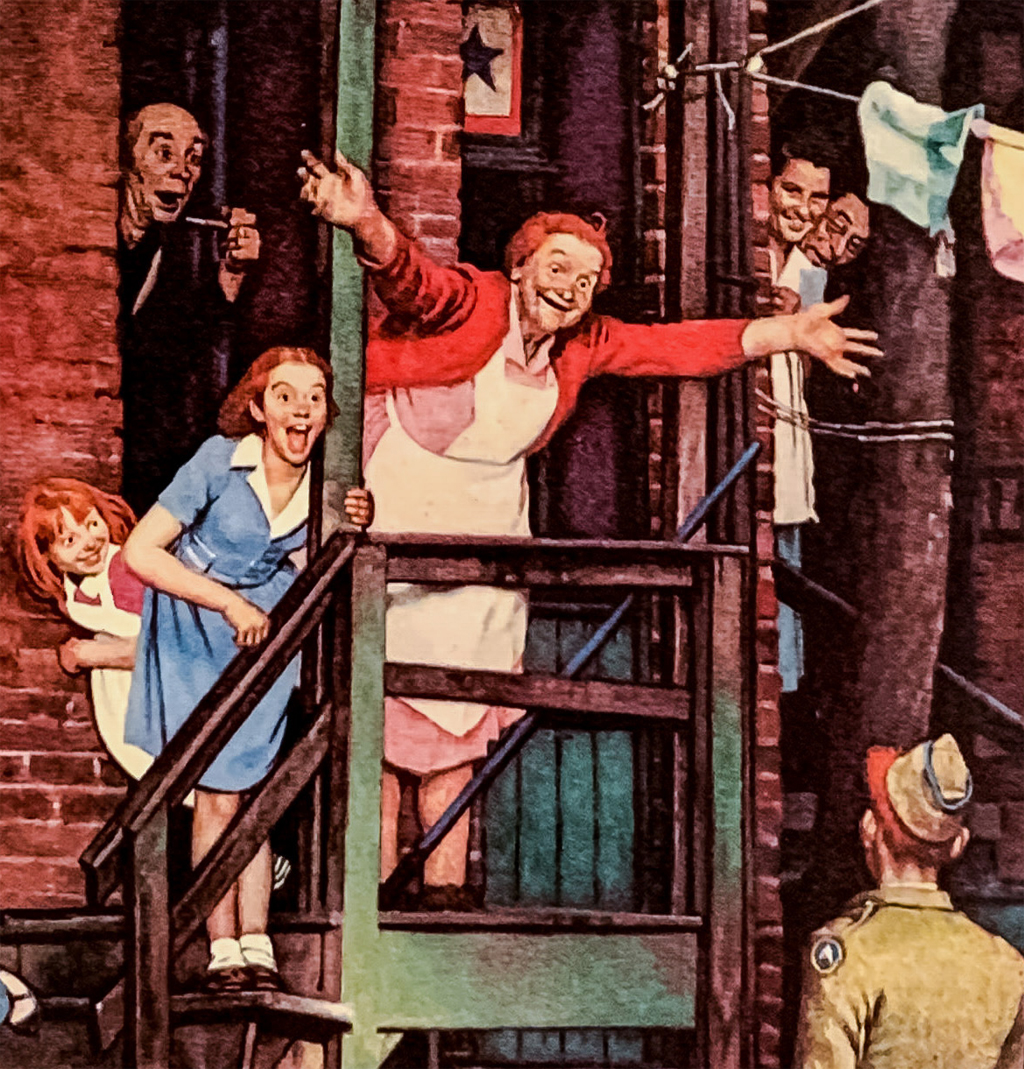
An analysis of one of Norman Rockwell’s most brilliant magazine covers, The Homecoming.
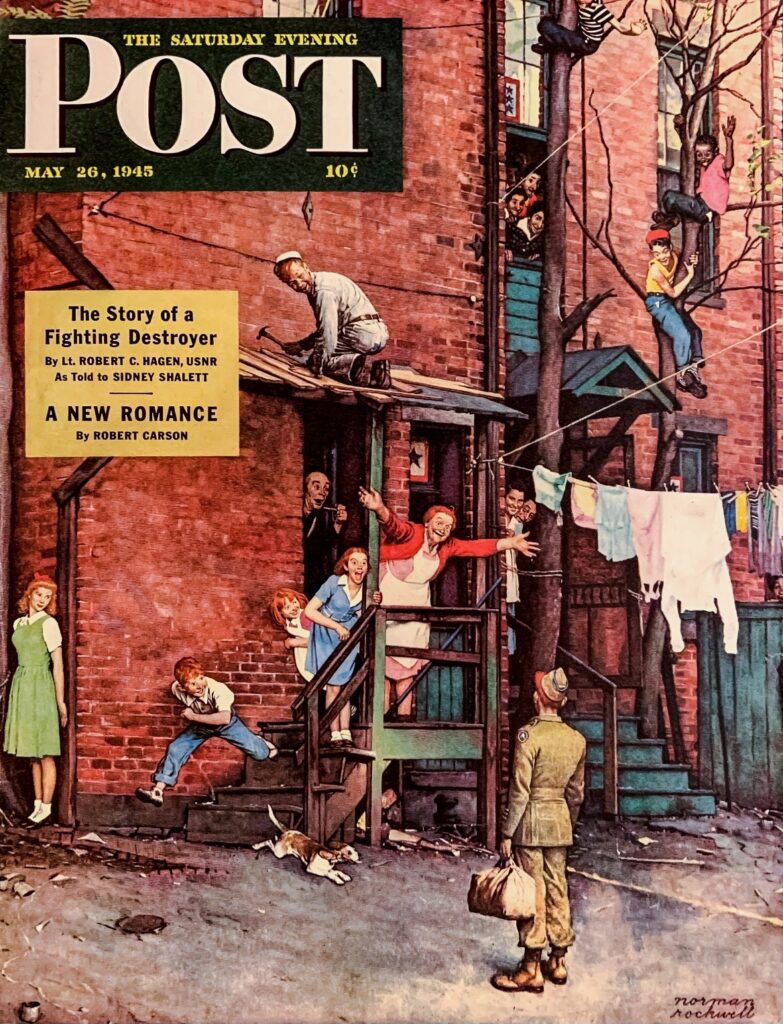
On May 26, 1945, the cover of the Saturday Evening Post depicted a returning soldier and the reaction of his family and friends to his arrival. While the cover had no official name, it was eventually dubbed “Homecoming G.I.” (The term “G.I.” was the common term for any member of the military, but especially those enlisted in the U.S. Army).
It’s important to note the context of this publication. The war in Europe had ended only 16 days earlier. Soon, fathers, sons, and brothers would be returning home. In reaction to this event, most of the newsstand magazines had covers with some variation of a returning veteran. How could The Saturday Evening Post outdo the competition? Fortunately, the Post employed one of the greatest magazine cover artists of all time: Norman Rockwell.
Rockwell could have dashed off a simple cover, sold plenty of magazines, and collected a hefty paycheck. Instead, he chose to craft a meticulous, complex portrait. A unique aspect of this painting is how many rules it broke. Here are a few examples:
BROKEN RULE #1: The main subject faces the viewer.
The soldier is clearly the central character—sightlines from every other character focus on him. Yet his body is turned at an angle as he faces away from the viewer:
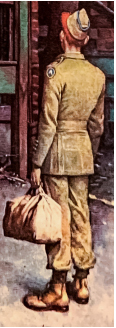
The only facial expressions we can see are those of the onlookers. Rockwell leaves the soldier’s reaction to our imagination. Is he happy? Overwhelmed? Overjoyed? Perhaps after what he saw and did in the service of a brutal war, he feared he didn’t belong here anymore. At this moment, he realizes that he does—or does not.
Everyone else on the cover is an open book, their emotions clear. The G.I. is a mystery because every veteran who comes back from a war is no longer the boy who went to war.
BROKEN RULE #2: Make it pretty.
Let’s face it—this place was a dump. There were no golden toilets or big-screen TVs inside that hovel. They probably didn’t even have WiFi or cable.
The typical wartime narrative painted America as a perfect place with perfect people living in perfect homes. Rockwell bucked that hypocrisy. He set the painting in a low-income area of Troy, New York (Christie’s). He wanted the viewer to see the dirt and grime and to hear the hammer bang on the overhang. The scene is humble, and it’s real.
The soldier doesn’t care about the faded brick, the sagging roof, or the worn paint. This is home. That’s all that matters.
BROKEN RULE #3: There is only one main subject.
It seems clear that the soldier is the primary subject of the painting. After all, the painting is usually called “Homecoming G.I.” However, I assert that the mother is also the main subject.
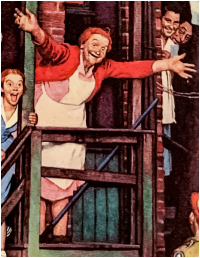
Located near the center and bigger than almost any other figure, she is beautifully plain and plainly beautiful. Her bright red sweater and red hair make her pop out of the scene. They frame a worn face infused with joy and adorn a portly body that radiates delight. She is the Sun in this Solar System. Everything in the scene orbits around her.
The soldier is still the main subject. He’s just a different main subject than his mother.
BROKEN RULE #4: Keep it innocent.
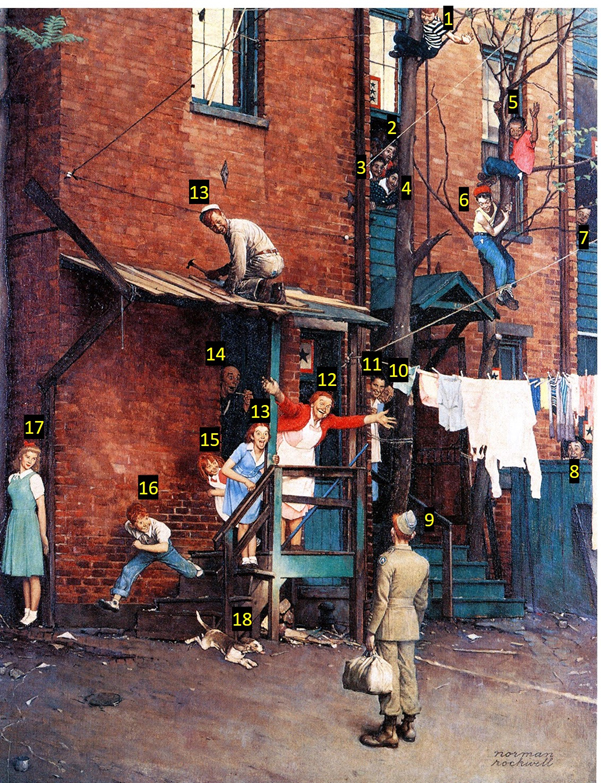
This painting was for the general public in a time of great prudence. Even gently lurid images were verboten. However, examine the girl lurking around the corner on the far left:

A Mona Lisa smile graces her face. She may not yet be a woman, but she’s not a girl anymore, either. As the only figure clothed in bright green with a red bow on her hair, we are meant to notice her. However, no one else, including the soldier, has spotted her. Our clear view of the girlfriend sharply contrasts the obscured view of her returning soldier.
Rockwell’s presentation livens up his cover with a bit of mystery. Why is she unsurprised by the soldier’s arrival? Did the soldier tell her when was coming home? Why isn’t she running out to greet him?
The overt reason is that she wants to give the soldier a moment with his family. A more subtle reason is that his family and friends represent his past. The girlfriend represents his future.
BROKEN RULE #5: Don’t overcrowd the painting.
The magazine cover cut off the top and right sides of the painting. Other widely available online images show the entire scene without the masthead (see at the end of this document for the full painting). I counted 18 figures, including the soldier and that wonderful dog. It doesn’t feel crowded because of Rockwell’s skilled layout and his tactic of placing the least important people inside doors and windows to obscure them.
BROKEN RULE #6: Never include yourself in your paintings.
Rockwell broke this rule in many of his paintings. That’s him as the father in the doorway:

Rockwell did employ some conventional methods. The painting tells a story with a balance of static and dynamic elements. The least important characters are motionless and harder to see because they are in shadow or farther from the center.
The family members are the most important figures on the cover. To emphasize this, Rockwell brushes them with bold colors and sets them in motion. His brother and the family dog literally fly through the air:
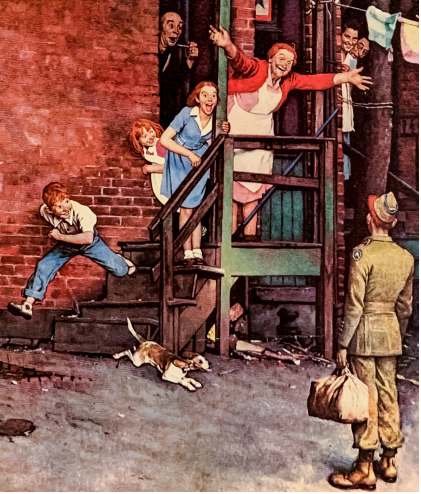
However, the soldier breaks this pattern. Clothed in drab khakis, he stands motionless with only a shock of red hair (a family trait) to set off his color scheme. The soldier is the eye of the hurricane. He keeps still while the action swirls around him. This makes his presence even more important to the viewer than his family or friends.
Speaking of the dog, he is the harbinger of the scene. Someone had to hear the G.I. first. We imagine the dog detected his particular cadence and desperately scratched at the door. When the brother opened the door and shouted, “Tommy!!!” that set the scene in motion.
At least, that’s what we can imagine. Rockwell leaves it to the viewer to decide what came before and after this iconic moment.
While Rockwell used a masterclass of artistic techniques in “Homecoming G.I.,” the theme of the painting is neither complex nor subtle. Rockwell described it thusly:
“[T]he soldier [is] surprising his family and friends in the backyard of his tenement home. His mother is holding out her arms to him, his little brother is running to meet him, people are looking out of windows, boys in trees are shouting, his girl is standing quietly to one side. The whole neighborhood is surprised and happy. He has come back. The war is over.” (My Adventures as an Illustrator, New York, 1988, p. 333).
Works Cited
The Homecoming. Christie’s, www.Christie’s.com/en/lot/lot-6204279. Accessed 10 Oct. 2024.
Rockwell, Norman, “Homecoming G.I.” The Saturday Evening Post, 26 May 1945, flic.kr/p/2mrkNo1. Accessed 10 Oct 2024.
Rockwell, Norman, My Adventures as an Illustrator, Abrams,1988.
One response to “The Best Homecoming Ever”
This is a test message.