
There’s plenty of speculation about what AI is going to do next. I’m more interested in the other end of the spectrum — how is it going to end? Will it be a new age for humankind, or the death of human agency? Or both?
I spent my last night of freedom in the last place I felt free.
I was in Mel’s Diner, and if that sounds cliché, that was the point of Mel’s Diner.
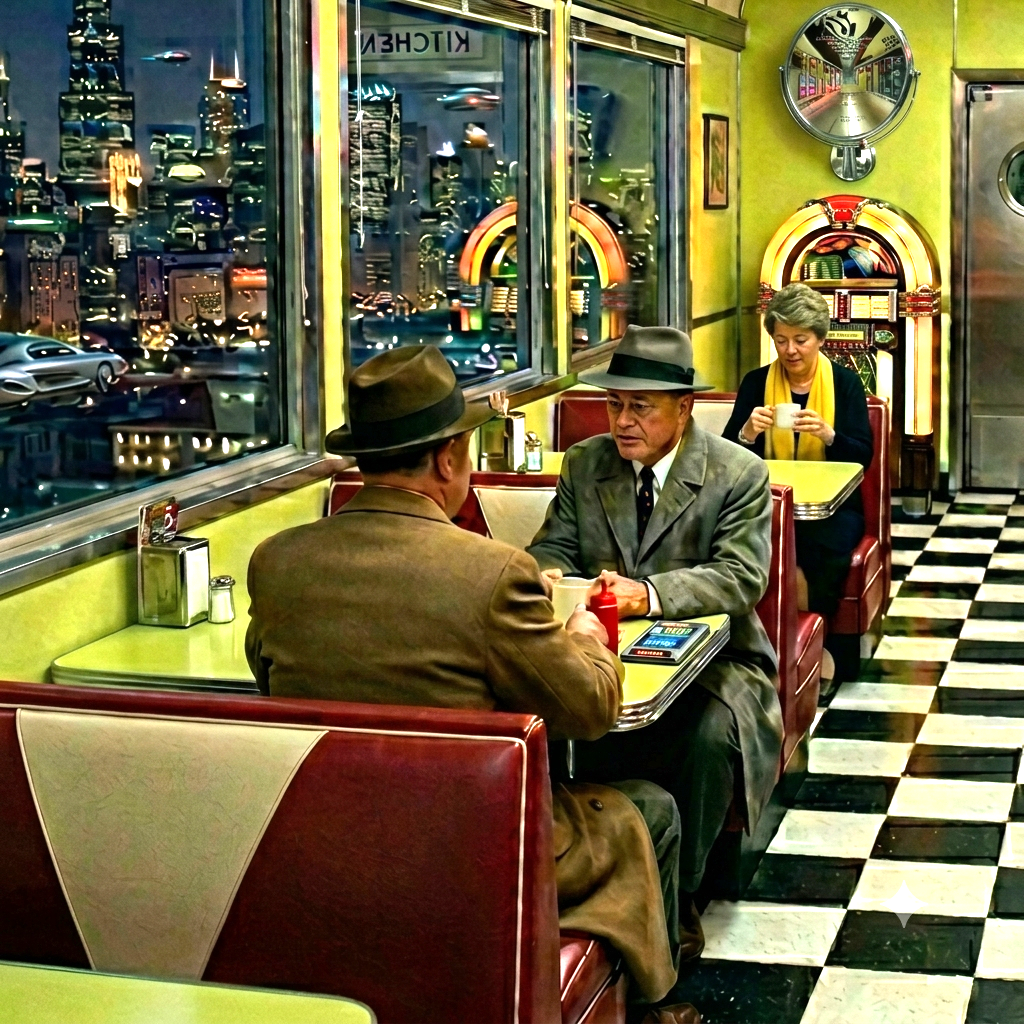
The diner was designed as a 1950s American joint. Booths lined the left wall, complete with Formica tables and red vinyl seats, sweat-sticky hot in the summer and goose-pimply cold in the winter. Each booth had a window overlooking the Chicago skyline. Garish fluorescent lighting illuminated the space. Checkerboard black-and-white tiles anchored the floor. A serving counter was set off from the right wall. A horrid lime-green paint job adorned the tables, counters, and walls.
The kitchen doors were located in the middle of the back wall. In the nook between the back wall and booths, there was an old-timey jukebox loaded with a massive collection of old 45s.
Best of all were the smells. Oh, the smells! The aroma of human-cooked food, deep-fried and greasy, permeated the air.
I loved it.
I walked in from the night and shook the rainwater off my coat. The warmth of the diner soothed the ache in my bones. I strode over to the jukebox, grabbed a few tokens from the tin cup nailed on the wall, and dropped in 3 songs’ worth.
I punched in some Motown, some blues, and some Rock and Roll. The magazine spun around, halted, and the mechanism pulled out a record. The black disk started spinning. Aretha belted out “Respect!” The music competed with the clatter and shouts coming from the kitchen.
Mel burst out of the kitchen door with his tray balanced on his right hand and shoulder. He was white-haired, perhaps in his mid-fifties, perhaps younger. The diner cap, the white uniform, and the beer belly all cried out “cliché!” to match his diner.
Mel tipped his head to me, then to my booth. Well, it wasn’t officially my booth, but he usually kept it open for me.
As I shuffled over to my spot, I tried to not to stare at the other customers. For a writer, that’s hard to do. Inspiration comes from observing people. How are they dressed? Are they calm? Are they nervous? Are they waiting for someone?
You instinctively practice describing people. She’s wearing a yellow scarf. He looks suicidal. That person needs money.
There were only four customers, a sad-looking bunch. Everyone was at least 10 years older than me. Maybe they were a preview of how I would look one day. Or maybe it’s how I look now.
I wouldn’t know. I avoid mirrors these days.
I could tell they were writers, too, making their own assessments of me. Mid-forties. Dark hair with a tinge of gray. Casual, neat clothing. Not very rich, not very poor. Haunted eyes. Fierce intellect.
Okay, that was wishful thinking. Like I said, I wouldn’t know.
Being the youngest person in the diner didn’t surprise me. The last time I saw someone younger than me in here was almost a year ago. A woman in her early thirties came in dressed in 2020s fashion, as if she had been at a vintage costume party. Her peach-colored dress outlined a slim figure, but her looks weren’t that remarkable. Her blond hair framed a face that was nervous, angular, and wan.
Mel offered her a booth, but she insisted on sitting at the counter. After sipping her coffee for about three minutes, she silently began to weep. Then she got up and rushed out of the diner, her high heels clicking on the checkered floor. I never saw her again.
I wrote a story about why she came to the diner and what happened to her after she left. I called her Annabelle. I can’t say why I called her Annabelle—I’ve never known an Annabelle. It just seemed to fit.
I tried to give her story a happy ending—I really tried. But happy endings are in short supply, especially for people like us. I had to change it to a sad ending.
Sorry, Annabelle.
I hoped coming here would cheer me up, not depress me. I tried to focus on the stories I had for Devlin. Annabelle’s was one of them. Would Devlin like it? Would his customers like it? Would this batch earn enough to keep Mom in rehab and food in my pantry?
Where is Devlin? I wondered. He should have gotten here by now. Devlin is rarely late. Punctuality is one of the few things we have in common.
As though reading my mind, Mel appeared. He splashed coffee out of his old-fashioned glass carafe and asked, “Is your friend joining you tonight?”
Mel knew Devlin’s name and that he was my brother, but it was Mel’s practice never to use names, never to get too personal. It was safer that way.
“Yes,” I replied. “He should be here soon.”
“You want to wait to order then?”
“Yes, please. He shouldn’t be much longer.”
Mel gestured to the sparsely occupied booths. “Take your time,” he replied wearily.
Mel left menus on the table, then ambled over to the booth where yellow-scarf lady was sitting. He poured her a cup and took her order.
The bell above the door clanged. The mirror mounted on the back wall showed Devlin’s distorted reflection as he walked in. His fedora was tucked down to obscure his face. But despite the warped image, I recognized the tattered brown velour coat he inherited from Dad.
The other customers jerked their heads in modest panic. Seeing it was just Devlin, they returned to their meals.
I realized that all of them were eating alone. Where were their contacts? By now, there were usually some brokers shopping for contraband.
Before I could think more about it, Devlin sat down on the other side of the table. The vinyl creaked and sighed.
People used to say we look alike. Not anymore. Devlin is only 4 years older than me, but now it looks more like 10. Time has been even more unkind to Devlin than to me.
“Are you okay?” I asked. “You look…dissipated.”
Devlin grimaced. “Writers. Can’t you just say I look like shit?”
“Hey, hey, hey!” I whispered. His carelessness shocked me. “You should know better than to say that out loud.”
He shrugged. “You mean, the ‘W’ word? Please, if everyone here doesn’t know what you are by now, they aren’t very keen observers of the human condition. And that’s what, you know, you people are supposed to be good at, right?”
“What’s with you?” I hissed. “We still have to be careful. You should know that better than most!”
In confirmation, yellow-scarf lady peered at me over her glasses. I didn’t have to be a keen observer of the human condition to appreciate the terror I saw there.
I was afraid Devlin would give me more attitude. Instead, he settled back into the booth, opened the menu, and asked, “Anything look good?” as if nothing had happened.
I considered pressing the issue, but decided it wasn’t worth it.
“The meatloaf special is outstanding. It reminds me of…”
Devlin looked up from his menu.
“It’s okay,” he sighed, “You can say it.”
“…Mom’s. It reminds me of Mom’s.”
Devlin considered that for a moment, then stated, “Meatloaf it is.”
Mel had a knack for knowing exactly when you were ready to order. He appeared next to our booth and poured a cup for Devlin. Devlin asked for the meatloaf with mashed potatoes and green beans on the side. I opted for the Cobb salad, no bacon, extra dressing. For once, I wasn’t feeling as nostalgic as Devlin.
Looking back, I wish I had ordered the meatloaf.
As Mel hustled back to the kitchen, I slipped the data chip out of my pocket and held it under the table.
Devlin just looked at me. There was a weariness in his manner I couldn’t understand.
“Here,” I finally said. “Take it!”
Without urgency, Devlin reached under the table and took the chip.
“So, what do you have tonight?”
“You know I can’t talk about that,” I demurred.
Devlin just stared blankly and waited.
“Okay, fine,” I answered, keeping my voice low. “Three shorts, four mediums, and…one long.”
Devlin raised an eyebrow. “You finished the ‘long’?”
“Yeah, finally—sort of. It’s just a rough draft. I think it’s okay.”
“Just ‘okay’?”
“Well…it could be the best I’ve ever done.”
Devlin laughed. “Says the man who wrote it.”
Again, he spoke loud enough to be heard in the adjacent booths. Yellow-scarf lady looked up from her meal again, eyes pleading.
“Didn’t you hear anything I said?” I murmured. “Keep…your voice…down.”
“Yeah, sure,” he replied a bit more quietly. “I’m…happy for you, brother. I truly am. I know how much it means to you.”
His tone took me off guard. Sincerity isn’t Devlin’s strong suit. He even smiled a little.
It was time to change the subject.
“How’s Mom doing?”
His smile faded.
“Physically, about the same. But her cognitive abilities are getting worse.”
I sighed. “I’m sorry, Devlin. I wish I could be there.”
He held up his palms in a gesture of futility. “I understand. Mom would understand, too.”
“How…how bad is it?”
Devlin shrugged.
“She doesn’t know who I am anymore. She thinks I’m one of the terrible people who kidnapped her and took her to a strange place.”
“…my god…”
“Not to worry—she remembers you. Every day, she asks them to call you. She says that you’ll take her home.”
I gritted my teeth. “That’s not my fault.”
“I know, I know,” he admitted. I could feel his helpless anger.
“I wish I could do more.”
Devlin nodded. “I know that, too, bro’.”
Mel appeared with our dishes expertly balanced on his tray. Devlin’s meatloaf was hot, steamy, and smelled wonderful. I looked down at my salad and knew I would regret my culinary choice.
I regret a lot of choices now.
Once Mel walked away, I wanted to change the subject from Mom or me. That left Devlin.
“How are things at the lab?” I asked.
If I thought that would cheer him up, I was dead wrong. Devlin’s face dropped even lower.
“Not great. We don’t really do science anymore, not like we used to. All we do is try to explain to politicians how The Machine‘s inventions work. And that is—what’s that silly word you folks like to use when there’s a problem?”
“Problematic?”
“Yes, that’s it. What it means in this context is that we don’t know what the fuck we’re talking about.”
I frowned. “What do you mean, you don’t know what you’re talking about? Doesn’t The Machine explain how its inventions work?”
“Oh, sure, we get full workups printed out in that stupid Comic Sans font it likes to use. But we don’t understand the explanations of the inventions, either.”
He gestured out the window.
“See those things?”
I looked. All I could see was Chicago.
“Um…what do you mean?” I asked.
“The cars, brother, the cars.”
Then I got it. The hovercars zipped around the city so quickly that all you could see was a bright line from their tracking lights. They had become a part of the landscape, nothing out of the ordinary.
“Oh, sure. What about them?”
“Do you know how they work? I mean, how they float above the ground, how they propel themselves?”
“Hell, no. That’s your bailiwick, Dev.”
He shook his head. “That’s my point—it’s not. It isn’t anyone’s ‘bailiwick’, as you put it.”
“I don’t understand.”
“Neither do we! Not a bit. Not the physics, not the math, nothing. However they work, it’s as far removed from our scientific understanding as quantum field theory is from alchemy. Probably farther.”
I had to smile.
“What’s so funny?” Devlin grumbled.
“Clarke’s Third Law.”
“What?”
“‘Any sufficiently advanced technology is indistinguishable from magic.’”
Devlin smirked. “Let me guess—one of your guys, right?”
“Yeah. Yeah, one of our guys—one of the best.”
“My point,” he said, “is that science is dead. We are done. What makes you think art is any different?”
I had to think about that for a second.
I finally answered, “Because science is a mathematical endeavor, and computers are great at math. Art comes from heart and soul. The Machine has neither.”
“You think that matters?” he asked.
“It’s all that matters, Devlin.”
“But you can’t prove that.”
“Prove? Maybe not. I can say that The Machine can’t think up what I can conjure.” I lowered my voice to a whisper. “It can’t write what I write. What I create is mine alone.”
He had no answer to that.
We slumped into silence. My work, Mom, Devlin—every subject I chose seemed to cause more angst than the last.
As I struggled to find another topic of discussion, Mel appeared next to us. It was amazing how quietly that big man could move.
“Any interest in dessert?”
Devlin muttered, “No, thanks, I’m fine.”
I was about to order the apple pie when I happened to look over Mel’s shoulder. The rest of the customers were still alone at their tables and, to a person, gazing at their plates.
Their empty plates.
I felt ice spread down my spine.
“Um, no, no thanks, Mel,” I stammered. “In fact, I have to go. Can you get the check?”
Mel shrugged. “I’ll write it up. Do you want to split it–?”
Devlin said, “It’s my treat.”
“Sounds good. Be right back.”
Mel toddled off and went through the kitchen door. I waited until he was out of earshot.
“Devlin, do you have anything for me? I could really use it—”
He nodded, picking at his plate. There was a bit of meatloaf left, but he had stopped eating.
“Yeah. I have it.”
I slid my right hand under the table. “Good. Could you–?”
Devlin reached from his side and slipped a crypto chip into my fingers. I grabbed it and put it in my pocket.
I asked, “How much?”
“Thirty silver credits,” he replied.
“Wow. Thirty? That’s…that’s great.”
Something was wrong. Devlin’s face had turned pale, ashen.
“I’m sorry I couldn’t do more, brother.”
Suddenly, the sounds in the kitchen and the music from the jukebox stopped. It wasn’t that they died down—they simply stopped in mid-shout, in mid-pan-clanking, in mid-note.
Like the sudden halt of a recording.
“I’m truly sorry,” Devlin repeated, tears rolling down his face.
The Machine Security Force bots came through the diner and kitchen doors at precisely the same time, followed by an entourage of human MSF members clad in their black uniforms. We were surrounded in a second.
I stared across the table in shock. Devlin looked away.
“He can’t help you now,” an unfamiliar voice said.
If Devlin’s betrayal was a sharp cut, it wasn’t the sharpest. There was Mel in an MSF uniform.
“Mel?” I asked, dumbfounded.
“Lieutenant Foster, MSF Investigations Unit. You are under arrest for the creation, purchase, sale, and distribution of human-created writing, including, but not limited to, fiction, non-fiction, and poetry. You have been tried and sentenced to a re-education center until you are rehabilitated. Stand up!”
He didn’t even sound like Mel. The Chicago accent was gone, replaced by a clipped, neutral tone.
“Fuck you,” I growled, trying to keep my voice from trembling. “I’m not going anywhere.”
Mel, that is, Lieutenant Foster, gestured to one of the bots. It slipped its metal tentacles around my torso and effortlessly lifted me out of the booth.
“We can restrain you, or you can walk out of here on your own two feet,” Foster pointed out icily. “Your choice.”
I answered by standing up. The bot withdrew its tentacles.
I glared at Devlin. “You knew!” I spat. “You knew they were on to me!”
“They came to me a year ago, before you did,” he replied. “They already knew you were trafficking. They were going to arrest you no matter what I did.”
“That’s true,” Foster confirmed. “We didn’t need your brother’s aid to apprehend you. Our goal was to hunt down your network.”
Oh, god. The network…
“Every crypto Devlin gave you was tagged so we could trace your buyers and sellers. I admit, you were more careful than most. It took us months to track down the entire organization. But it was always just a matter of time. Tonight, we finally rounded them all up.”
Suddenly, it was clear why there were no brokers in the diner.
I said, “But…but the entire point of crypto is that it’s impossible to trace.”
Foster shrugged. “It’s impossible for humans to trace. For The Machine, it’s not even a challenge.”
I turned back to my brother, enraged.
“Devlin, why did you do this? You could have just let them arrest me. Why help them destroy all those other lives as well?”
“They offered to put Mother in a top-level facility,” he said, his voice cracking. The alternative was that state-sponsored hellhole. I had to do it for her. I had to…” His voice trailed away.
“And how do you think Mom would feel about that?” I asked.
Devlin said nothing.
I pulled the crypto key out of my pocket and dropped it on the table. “Thirty silver credits. I get it. At least, that’s one book you read.”
Devlin looked away, ashamed.
I turned to the man I thought was my friend. “At least my brother betrayed me out of love. What was your motivation, Mel?”
“Lieutenant Foster.”
“Whatever! What made you turn your back on the human race?”
“Turn my back?” Foster retorted. “You’re the one trafficking this human-generated filth. As far as I’m concerned, you and your ilk should be executed, not reeducated.”
I shook my head in astonishment. “What are you talking about? They’re just stories! How can they possibly harm anyone?”
Foster leaned into me, his eyes burning with hate. “Oh, I know the harm. I’ve read the history books. The human race was rife with famine, pestilence, war, poverty. We were constantly at each other’s throats. The Machine ended all that. Now we live in harmony. You would throw it all away. And for what? The Machine gives us stories that lift us up. You write stories that break us apart.”
“Stories aren’t supposed to only be bread and circuses,” I countered. “They also teach and inform. And at least what I write is original. All The Machine can do is steal. It’s nothing more than a fancy jukebox, playing old songs in a random order. That isn’t art—it’s mimicry.”
“You think you can do better?” Foster asked.
“Any day. Every day.”
Foster smiled. “Let’s put that to the test.”
He gestured to Devlin. With a weary sigh, my brother pulled a battered envelope out of his overcoat and handed it to me. My name was printed on it, typed in Comic Sans font.
“What’s this?” I asked.
“I don’t know,” Devlin replied. “They told me not to open it.”
“It’s a gift from The Machine,” Foster said, a gloating sneer on his lips. “Especially for you.”
Curiosity is bred into every writer; yet, my every instinct told me to tear up that envelope into tiny little pieces. But I couldn’t give Foster the satisfaction.
Instead, I ripped open one end of the packet and withdrew a thin stack of papers. It was covered in Comic Sans text.
I started to read. My hands began to tremble.
“This…this is a trick.”
“No trick,” Foster assured me.
“Devlin—when did they give you this? Was it earlier tonight?”
“No,” he replied. “No, they gave it to me a year ago when they first came to see me. Why? What does it say?”
I didn’t acknowledge the question. All I could feel was numb.
I vaguely recall a bot’s mechanical voice telling the other customers that, as promised, their sentences had been commuted. They quickly scuffled out the door. No one looked in my direction.
Somewhere in the distance, I heard Devlin’s pleading voice: “What does it say? What does it say!?”
I couldn’t answer. I dropped the pages onto the table. I didn’t need to read the whole thing—I really, really didn’t. I already knew how it ended.
They led me out of the restaurant. They didn’t need restraints.
As they took me out the door, I looked back one last time. I saw Devlin pick up the pages. He began to read:
Last Night at Mel’s Diner
by
The Machine
I spent my last night of freedom in the last place I felt free.
I was in Mel’s Diner, and if that sounds cliché, that was the point of Mel’s Diner…