

This is a sordid tale of physics, Bessel functions, and the lengths we went to for a passing grade. It’s high time I came clean!
Is confession really good for the soul? Let’s put that to the test.
I’m going to tell you a dark, deep secret from my distant past. I call it The Bessel Function Caper.
In my senior year at North Carolina State University, I took a course in plasma physics. This isn’t the plasma in your blood. In physics, a plasma is a gas composed of charged ions and electrons. Plasmas occur in everything from neon lights to that big bright thing in the sky called the Sun. Fusion power generators create a hot, dense plasma in an attempt to emulate the Sun. This makes plasmas a big deal in the scientific and business communities.
The plasma physics class included a lab experiment that required a team of students. Every team consisted of 5 students. Each team would set up its version of the experiment, collect data, analyze it, and produce a numerical result. Standard science stuff.
At least, it seemed like standard science stuff. I didn’t realize that the experiment would take a very weird direction.
I lucked into getting on a great team. Jack, Harry, Steve, and Clark were smart, hard-working guys (names changed to protect the guilty). A good team was essential. There was a lot of grunt work to do, and no single person could do it all. We had to work together. That was the point of the entire task. In the real world of research, everyone works in a team. The days of the lone scientist were over long ago.
The data collection proceeded without any big hitches. But after that, we had to analyze the data. That’s when things went astray.
Roadblocks are to be expected in an activity like this. Our team was able to handle most of them without too much trouble, except for one problem—a Bessel function.
Bessel functions represent solutions to a class of differential equations that look like this:
\(x^{2}\frac{d^{2}y}{dx^{2}}+x\frac{dy}{dx}+(x^{2}-\alpha^{2})y=0\)
This type of equation occurs in many physical systems. One cute example is the oscillations of a circular membrane:
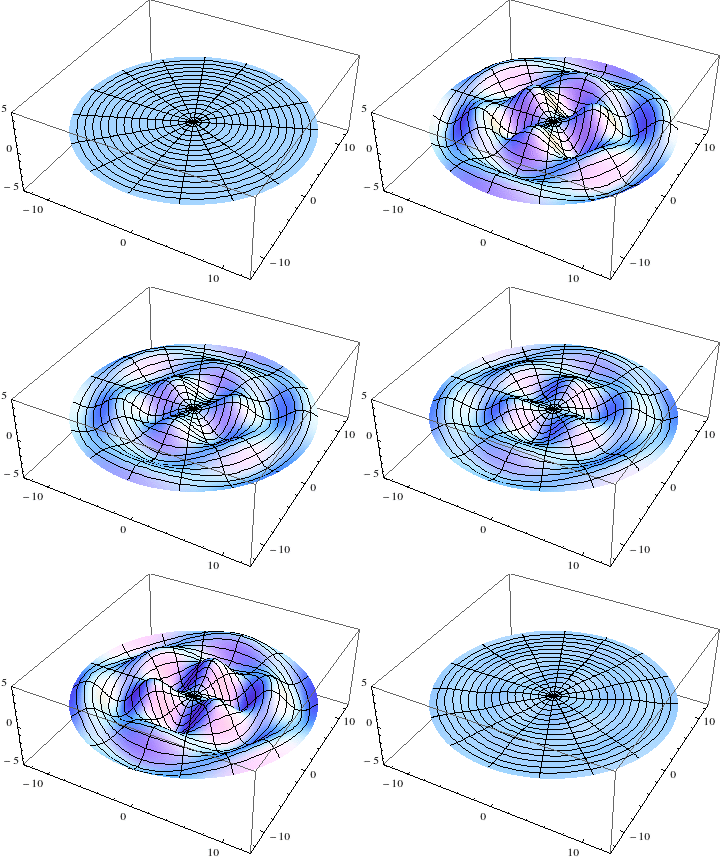
Anytime you hear the beating of a circular drum, you are hearing a Bessel function.
There are different kinds of Bessel functions depending on the physical constraints of the system under study. The most common solution is Bessel functions of the first kind, denoted as Jn(x). The values of this function were tabulated in many sources.
However, our experimental analysis required a version of the Bessel function called the Spherical Bessel function jn(x). It is based on a slightly different equation from the standard Bessel function and, as the name implies, works well for problems with spherical symmetry, like a globe. If you wanted to characterize the vibrational modes of the Sun, the Spherical Bessel function is a good starting point.
As ubiquitous as the Jn(x) function was in the math literature, the jn(x) function was a rare beast. None of us could find a table of its values or a quick way to evaluate it. Nowadays, you can find this stuff on the Internet, but back in the Stone Age of 1977, we were out of luck.
This wasn’t the only question we had about the experiment, but it was the most pressing. We asked the professor’s research assistant (RA) for a meeting where we could get some of these questions cleared up. We were especially interested in how to find the values of this troublesome Bessel function.
We didn’t specify exactly what our questions were going to be. It wasn’t a conscious decision to do that, but it turned out to be important.
The RA set up a meeting in the professor’s office while the professor was teaching another class. The team got to the office a few minutes before the appointment time. None of us wanted to miss out on any of this information, given the stakes–this lab represented a BIG part of our final grade. Since we arrived early, the RA wasn’t there yet.
As we waited for the RA to arrive, Harry idly glanced over the bookshelf covering one wall of the room. Suddenly, he called out, “Hey, guys, look at this!”
We gathered around. Harry pointed to a 3-ring binder. The title on the binder read:
SPHERICAL BESSEL FUNCTION
Oh, ho!
Harry pulled the notebook out of the shelf and opened it. The pages contained a handwritten table of the vital Bessel function values. It was exactly what we needed!
But after that initial excitement came a pregnant pause. We were all thinking the same thing.
What now?
We could ask the RA if we could use the notebook. But what if he said, “No”? After all, the professor didn’t mention he had this handy notebook. Maybe part of the assignment was to figure out how to calculate this function on our own.
Maybe we could, maybe we couldn’t. Did we want to take that risk? We may have just been undergraduate physics students, but we were experienced enough to know it came down to one question:
Do you ask for permission or do you ask for forgiveness?
We didn’t even have a debate. Steve simply asked, “Who has the data set?”
“I do,” I answered.
“Call out the data to Harry. He can call out the Bessel function values. Clark, copy down the data numbers and their Bessel function values.”
“I’ll watch the hallway,” Jack offered.
“Awesome,” Steve replied. “Let’s do this!”
I loved this team.
And so we did. We quickly obtained the Bessel function values. We knew we had one shot at this and needed to get it right the first time.
As I neared the end of the data values, Jack slipped back into the office. “Here he comes!” he whispered.
I called out the last data point, and Harry responded with the Bessel function value. A moment before the RA came through the door, Harry closed the notebook and inserted it back into the bookshelf.
Whew!
The rest of the meeting went as planned, except we didn’t ask about the Bessel function.
That should have been the end of it. All we had to do was complete the data analysis, write it up, and hand it in.
But fate wasn’t done with us yet.
Everyone is on the honor system to never collaborate with any of the other teams. That would be cheating. We didn’t do that, of course.
But…
There’s always some leakage around the corners in an assignment like this. In this case, it came in the form of a rumor that got back to one of our team members.
For all its complications, this experiment was designed to generate one definitive number. I don’t remember what the measurement implied, but I do remember we got an answer that seemed reasonable.
But was it the right answer? Up to that point, we had no way to verify if that was the case.
Then our teammate came with the news that all of the other teams got a particular result. However, it wasn’t the same as our result. Our answer was different—substantially different.
In an experiment like this, it isn’t unusual for teams to get different answers. It also isn’t unusual for all the teams to get the same answer. What you don’t expect is for all of the teams to get the same answer except for one team. And you hope to God it isn’t your team.
We collectively groaned and knew what this meant. We probably made a mistake somewhere in the data collection or data analysis. Retaking the data was infeasible. What excuse would we have? That we heard we had the wrong answer? No, we couldn’t do that.
Our only alternative was to pound on the data analysis, then cross-check each other’s work. That occupied us for the next several days.
The end result? We came up with the same answer as before. Furthermore, everything looked great. As far as we could tell, we took the data properly, did the calculations correctly, and had an accurate result. We couldn’t figure out how the other teams had a different outcome.
Was there something we were missing? Was the Bessel function data we, um, acquired, somehow incorrect? Were they bogus Bessel function values planted by the professor to catch any team that stole a look? No one was sure.
The team had one final discussion on what to do. We went round and round until Harry announced:
“We don’t have any choice but to turn it in. Let’s go for it.”
We all agreed—let’s go for it. We wrote it up, handed it in, and trusted we had done our best.
Several days went by. Then, a week. We knew it would take a while for the RA to grade the labs. Still, it was a teeth-grindingly torturous time.
Finally, at the end of one of the plasma physics classes, the professor asked our team to stay for a moment. He told us, “Gentlemen, the RA has asked you to come by his office. Can you meet with him now?”
Every team member’s heart did a little ka-thump. What was this meeting for? All sorts of scenarios came to mind, most of them unhappy.
But what else could we do but suck it up? Everyone agreed to go to the RA’s office.
Our trip to the RA’s office was a harsh, cold affair. None of us knew what was going on. Does anyone know what this is about? No. Any ideas? No. Does this have something to do with the Bessel function? God, I hope not.
The RA’s office door was open. He gestured for us to all come in, close the door, and sit down. I recognized our lab report on the desk. The front page was turned down, so we couldn’t see the grade. Damn.
The RA leaned over his desk. “Guys, I finished grading all of the plasma physics labs. The outcome was kind of…unusual.”
No kidding, I thought. Here it comes…
“I don’t know if any of you heard, but all of the other teams got the same result.”
Really, no, no, we hadn’t heard…
“But it was different from what your team got.”
Oh, golly, how about that?
“The thing that I don’t understand is…”
Yes? YES???!!!
“…why was you’re team the only one that got the right answer?”
We…what?
Yep, we beat the odds. Our answer was right. Everybody else was wrong.
As to why? Maybe we had the correct Bessel function values and everyone else did…whatever they did. Honestly, we didn’t know how the other teams dealt with this issue. We certainly weren’t in the mood to investigate the matter.
All we could do was shrug our shoulders and tell the RA that we did the best we could. We didn’t know why the other teams got the same wrong answer. At least that was the truth, as far as it went.
During the discussion, I held my breath waiting for the RA to ask us how we got our Bessel function values. He never did. I have no idea how we would have responded.
And that’s where it stood. We aced our lab project, I got an A for the class, and it was the last time I had to deal with plasma physics for the rest of my career.
Whew! I was right—confession is good for the soul.
Now, let’s hope the professor never sees this article. That would be awkward…